
Stonewall County Parole Versus Probation
Parole and probation both permit a person to live outside a jail or prison under stated rules, but they arise from different decisions. The Texas Board of Pardons and Paroles decides parole for eligible TDCJ prisoners. The TDCJ Parole Division then supervises a person released on parole or mandatory supervision. A Stonewall County court imposes community supervision, commonly called probation, through a judgment or later order. The court record and supervising department are therefore the sound sources for probation.
A Stonewall County jail release entry may say where a person went, but it does not by itself establish the full supervision term. Likewise, parole eligibility is only the point when review may occur. It is not approval and is not physical release. Probation can begin without a prison release at all. Matching the record to the right authority prevents those events from being blurred together.
| Point | Parole | Probation |
|---|---|---|
| Source | BPP vote after TDCJ confinement | Stonewall County court order |
| Supervisor | TDCJ Parole Division | Community supervision department named by the court |
| Best proof | TDCJ status, vote result, and release record | Judgment, docket, and supervising-office confirmation |
| End point | Parole discharge or sentence end | Court-ordered completion or discharge |
- Parole
- Conditional release from prison before the sentence fully expires.
- Probation
- Court-ordered community supervision, often imposed instead of jail or prison.
- Mandatory supervision
- A separate Texas release process based on eligibility, time, credits, and board review.
- Discharge
- The formal end of the sentence or supervision obligation.
Verify Stonewall County Post-Release Supervision
Start with the custody system, not a broad name search. A person released from the Stonewall County jail may have bonded out, completed time, transferred, or begun a court supervision term. A former TDCJ prisoner may instead be on parole, mandatory supervision, or fully discharged. The identifying number and source record make the distinction clearer.
- Ask the Stonewall County Sheriff for the booking/release entry and its exact disposition. A transfer is not community release.
- For probation, inspect the judgment and later orders through the combined District/County Clerk. Use the separate Justice of the Peace when that court owns the matter.
- For parole, collect the full name plus TDCJ or SID number. If neither is known, use the exact date of birth when contacting TDCJ.
- Check the TDCJ Inmate Search only for current prison information. It is not a released-person archive.
- Call BPP review information at 844-512-0461 for a vote or review result. After a favorable vote, ask TDCJ release processing at 512-406-5202 whether release has actually occurred.
- Confirm the assigned supervision office and current reporting status with the responsible parole or probation authority.
The official Texas parole review page illustrates the file-review process used before a release decision.
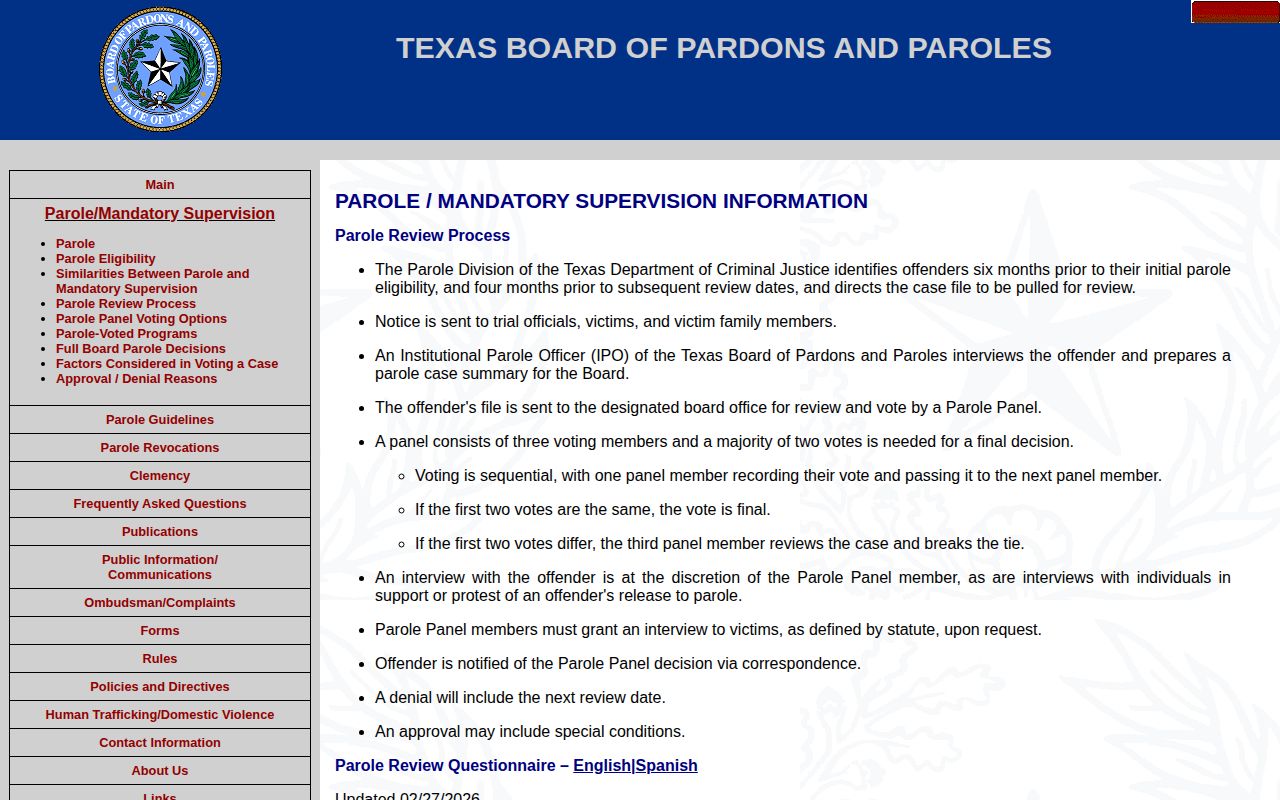
The state process shown is not a public courtroom hearing calendar. It helps distinguish a review step from a completed Stonewall County release or an active supervision record.
Record the date and agency behind each answer. A court order can precede physical release, and a favorable parole vote can carry a future date, program requirement, or unresolved hold. Current custody and supervision are separate facts.
Stonewall County Supervision Contacts
No county-specific parole field-office address was verified in the research. The accurate route is to let TDCJ identify the assigned office from the person’s record. Probation questions should go first to the court record, which identifies the community supervision authority and controlling order. Do not assume that the nearest office or an old reporting address remains assigned.
TDCJ Parole Division
Release and supervision: 512-406-5202
Email: io@tdcj.texas.gov
Review status before release: 844-512-0461
Review email: bpp-pio@tdcj.texas.gov
Stonewall District/County Clerk
128 Town Square Lane, Drawer P
Aspermont, TX 79502
Phone: 940-989-2272
Email: holly.mclaury@stonewallcountytx.org
Hours: Monday-Thursday 8 a.m.-4:30 p.m.; Friday 8 a.m.-noon; lunch noon-1 p.m.
The clerk can supply the judgment, sentence, bond order, dismissal, and later docket events that explain the court side. Those documents do not provide a live parole check. For that, use TDCJ with the person’s identifiers.
Stonewall County Supervision Conditions
Conditions are the written rules attached to release or community supervision. They can include reporting, travel limits, program attendance, payments ordered by the court, or other case-specific terms. Only the current order or supervision record establishes the actual conditions. A jail entry, court summary, or old web result should not be used to infer them.
A reported violation does not automatically prove revocation. The supervising authority investigates and follows its legal process. A warrant may result in custody, while another response may change reporting or impose a sanction. An absconder is generally a supervised person whose whereabouts are unknown after failing to maintain required contact. That label must come from the responsible agency, not from silence in a public search.
Stonewall County Supervision Discharge
Supervision ends through a formal record, not merely because the person stops appearing in a current-custody search. For parole, TDCJ can confirm whether the person remains under supervision or has discharged. For probation, the court docket and supervising department can confirm completion, early termination, revocation, or another outcome. A discharge ends the specified supervision obligation. It does not rewrite the court history.
Texas public-information rules and court-access limits still apply to each record. Expunction removes qualifying records through a court process, while an order of nondisclosure restricts many forms of public access without erasing every government record. Neither should be inferred from a failed search. For the underlying jail release event, use the county release path described on the Stonewall County released-inmates search.
When sources conflict, ask for the dated discharge or supervision order. A portal label may lag, and two agencies may be reporting different parts of the same case.
Stonewall County Parole File Review
Texas does not hold a formal public hearing for each parole or mandatory-supervision review. Instead, BPP panel members review the file and vote individually. There is therefore no Stonewall County parole-hearing calendar to check. A next-review date is not a courtroom hearing date, and eligibility does not guarantee a favorable result.
The official file-review process explains how the case moves through review. Vote results use codes such as FI variants, RMS, NR, SA, and DMS. Read the exact meaning on the BPP vote-options page. Some favorable votes require a program or set a future release date. New information may also cause approval to be withdrawn.
The written board reason is the durable decision record, subject to safety and confidentiality limits. After a favorable decision, contact release processing because the vote itself is not proof the person has left custody.
Stonewall County Parole Warrant Checks
TDCJ describes its internal parole-warrant operations, but that page is not a public statewide list of named parole absconders. This is a crucial local search limit. Failure to find a name there cannot establish that no warrant exists.
Verify the person’s supervision status with TDCJ and use official court or law-enforcement records for a named warrant inquiry where access is lawful. Do not treat a third-party label as proof. If immediate safety or a required report is involved, contact the responsible public agency directly. VINELink may deliver custody-status notices for a participating reporting agency, but it does not replace the parole authority’s warrant record.
Keep the claims narrow: TDCJ can confirm parole supervision, the board record can document review, and the responsible agency can address warrant status. One system’s absence proves none of the other facts.
Read Stonewall Parole Results
A parole result needs three checks: identity, decision code, and implementation. BPP accepts the person’s name with a TDCJ or SID number, or a date of birth when the number is not known. The review result can show a favorable or unfavorable action, but the code controls its meaning. An FI result can include a future date or program. NR means no release at that review. Other codes address mandatory supervision, serve-all actions, or additional review. Use the official vote-options definitions instead of expanding an unfamiliar code from memory.
Implementation is separate. A favorable vote may still be followed by program placement, release planning, a detainer check, or new information. Call TDCJ release processing for the current stage. Once release occurs, ask the Parole Division to identify the assigned office and whether supervision is active. A VINELink change can support the timeline when a participant reports it, but it does not explain the parole conditions or prove discharge.
Probation results require the same care with different records. The signed Stonewall County judgment states whether community supervision was ordered and gives its term. Later orders may modify conditions, revoke supervision, extend it, or end it early. The docket is a route to those documents, not a substitute for reading them. When a portal has no case, contact the combined clerk rather than concluding that probation never existed.